In order to take your business to a high level, make good profits, and attract more and more leads, you need to collect all the data about them correctly and competently. Although companies use various tools and methods of data collection, they may not always be effective.
Therefore, in this article, we will tell you in detail about the system that is ideal for such purposes, its functions, advantages, disadvantages, and other features. DMP platform is one of the best methods of collecting information for marketers. With the help of this system, business owners will be able to achieve significant results.
What is a DMP Platform?
A DMP is a data management platform that collects user information from various sources, manages this data, and organizes it appropriately. A DMP platform searches for information based on user behavioral data.
Thus, having collected everything necessary, the system segments, filters, and accumulates data, helping companies determine the interests of the target audience and further use it to improve targeting and advertising.
How does the DMP system work?
The process of working with a DMP platform is quite simple and straightforward. The main purpose of this system is to track user actions, collect data about them, and implement marketing strategies.
When a customer visits a site or page and performs any actions there (clicks, likes, orders, etc.), their activity is tracked using the embedded DMP code on the site. In addition, the system collects the data that the user has shared himself (name, age, place of residence, etc.).
In this way, all data on potential customers is accumulated and stored, which is then segmented into groups based on certain characteristics. After that, advertisers can analyze the anonymous profile of a potential customer and use it to create an offer that will be more targeted to the selected category of users.
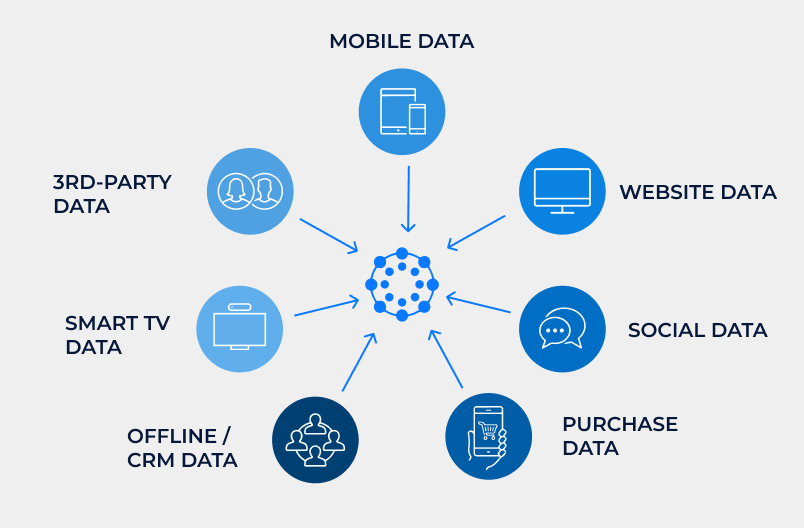
How Does a DMP (Data Management Platform) Help Marketers?
DMP is a system for effective work of marketers, which helps to analyze the audience based on the collected data. Marketers can understand and predict the behavior of users on the site, their preferences and potential purchases. Also, based on the visited sites, specialists are able to predict the gender, age and hobbies of people who visited the site.
After analysis, marketers know what to do next. The data management platform helps to conduct advertising campaigns by analyzing interaction with content, and thereby attracting the right audience to the product.
In turn, correctly selected advertising by marketers guarantees the progress of the company and an increase in the number of leads interested in the company's products or services that you are advertising.
DMP System Functions
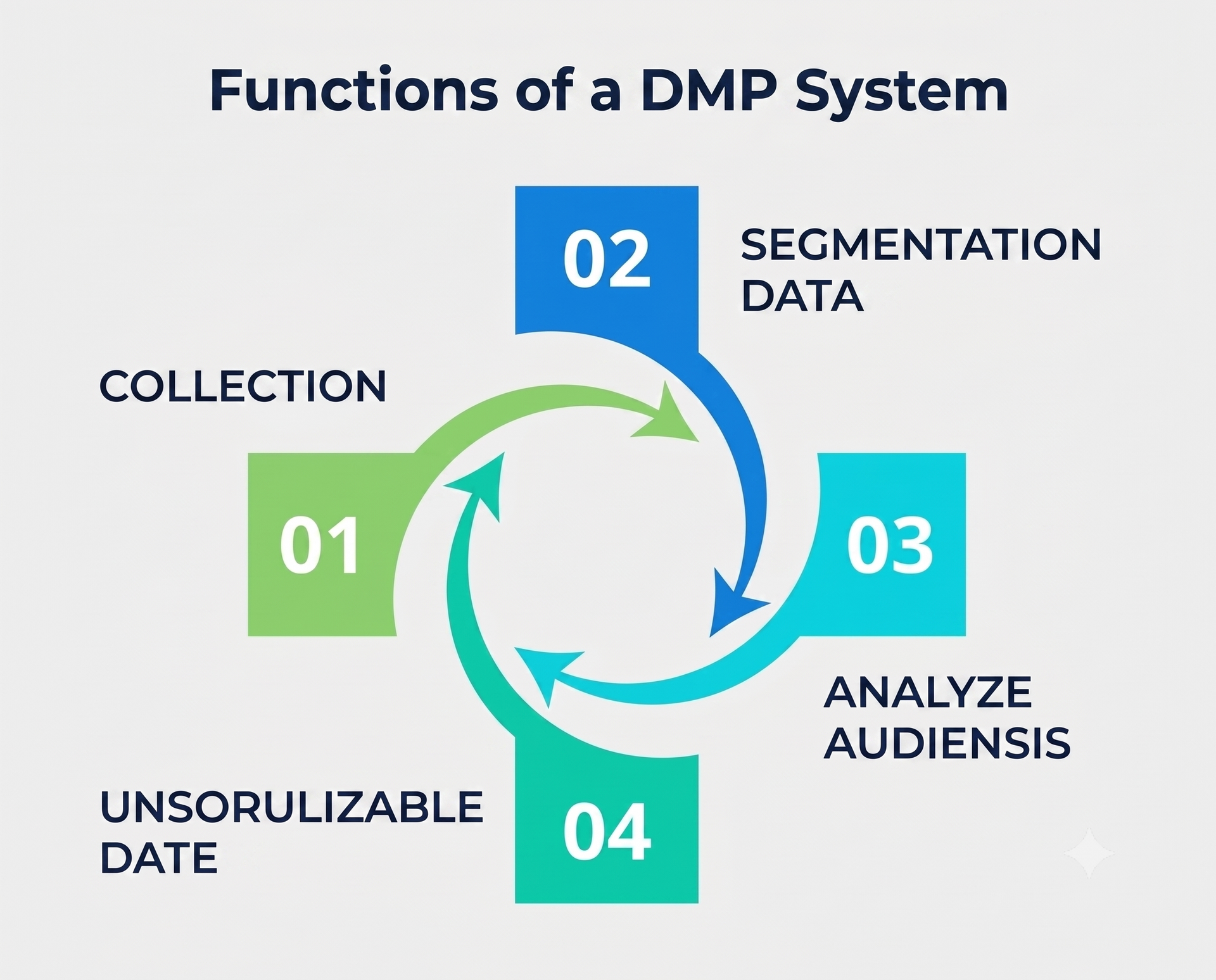
To better understand how a DMP system works, it's worth familiarizing yourself with the functionality of this platform. So, what functions does a data management platform perform?
The primary function of a data management platform is to collect user data that may be of interest to both marketers and the company as a whole.
Next, data segmentation. Using special algorithms, all the actions of a potential client are systematized and sorted. At this stage, the marketer already has an idea of the person based on the actions performed.
The DMP system also helps to conduct audience analysis. The process involves a thorough study of potential customers, their preferences and needs. At this stage, specialists identify information that can be useful for improving advertising and product sales.
After searching, analyzing, evaluating, and other data processing functions, information about user actions can be used in further work. Specialists choose how to work with this data, planning marketing and advertising strategies to promote products or services in the market.
What Data Can Be Managed Using a DMP System?
One of the features of a DMP platform is the collection of different types of user data. This information can be divided into 3 categories: first-party data, second-party data, and third-party data.
- First-party data or own data is data that is collected based on the analysis of user behavior on a site or page. For example, it can be actions such as likes, comments, clicks, search queries, visits, etc. In addition, data that the user has shared himself is also collected: location, status, education, email addresses and other socio-demographic characteristics.
- Second-party data – this type of data is also called partner data and is similar to the previous one, where behavioral, geolocation and demographic characteristics of the potential client are taken into account. However, the collection does not take place within your company, but with the help of a third-party organization. Such a search is carried out for a broad idea of the target audience.
- Third-party data is a third-party type of data that is significantly different from the previous two. The peculiarity of this data is that it is additional data that complements other information about the client. Third-party data is not based on the analysis of user behavior, but relies only on information collected from sources that was provided by the user.
Advantages and Disadvantages of DMP Platforms
Before you involve a data management platform in your work, you should pay close attention to all the pros and cons of implementing this system. Of course, the DMP platform is an extremely useful tool in the work of marketers, but in some cases it can also become a stumbling block. Having analyzed the work of DMP, we have prepared a detailed description of both the advantages of the system and its disadvantages.
| Name | Pros | Cons |
| Cost | - | |
| Ease of use | + | |
| Data optimization | + | |
| Information segmentation | + | |
| Extended customer information | - | |
| Integration | + | |
| Advertising | + | |
| Safety guarantee | + | |
| Cost and revenue optimization | + | |
| Data retention period | - |
Advantages of DMPs
A data management platform can boast a number of advantages. Among the most common are:
- Systematization of data in one place;
- Clear segmentation and optimization of user data;
- Simplified collection and processing of large amounts of data;
- Integration with advertising platforms;
- Improving marketing strategies;
- Ensuring the effectiveness of advertising campaigns;
- Expanding the target audience;
- Saving time on finding the target audience;
- Optimization of company costs and revenues;
- Guaranteed user data security.
Disadvantages of DMPs
Although DMP is a real godsend for marketers, there are some disadvantages to using this system. We have highlighted the following:
- Too high a cost for software;
- The need for constant equipment maintenance;
- Search and processing only anonymous user data;
- The need for data management experts;
- Sometimes it's not the accuracy of analytical results and decisions;
- Short data retention period.
How is a Data Management Platform Different from Other Platforms?
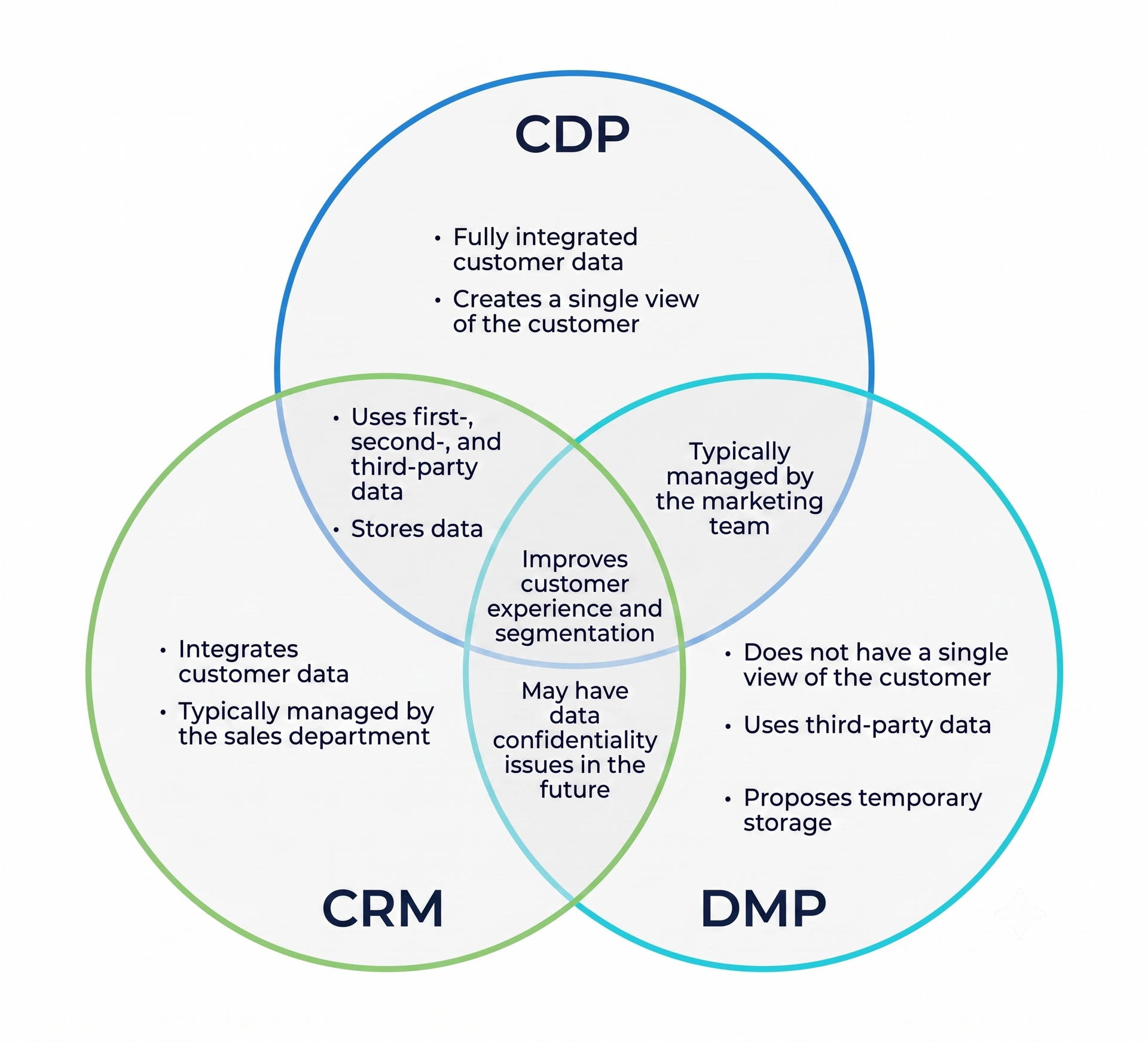
Both DMP, CDP and CRM systems are platforms for collecting customer information. For the harmonious operation of the company, it is worth choosing those platforms that can help you in your work. Therefore, before implementing a CDP, CRM, or DMP platform, learn about their essential differences.
DMP vs CDP
As we noted above, a DMP system is a data management platform that collects user information, helping marketers create personalized advertising messages and campaigns for specific audience segments.
As for CDP, it is a system that collects and processes data from various online and offline sources, allowing business owners to find their target audience and attract more customers who have used their company's services. The difference is that the collected user data is not anonymous. Thus, the CDP system can improve business efficiency and productivity of the enterprise.
DMP vs CRM
CRM is a customer relationship management system that deals with information only about customers who interact with a company. The platform tracks all user actions, their transactions, clicks, visits, etc. A CRM system can, like others, search for data, segment it, and process it to help businesses easily find and interact with their target audience.
A prime example is the GudHub platform, which positions itself as a CRM system and works with customer data. However, this platform also performs the functions of a DMP system, providing comprehensive collection and analysis of user data.
How to Choose the Right DMP Platform?
In order to choose the ideal DMP system for your business, you should pay attention to the following important factors:
- Objective: Predict the goals that the company plans to achieve;
- Cost: Rely on the company's budget, considering that the DMP system will require constant hardware support and software updates;
- Functionality: Pay attention to the tools integrated into the system that can help in working with user data;
- Security: Be vigilant when choosing a data management platform, paying attention to the reliability of the provider.
Overall, choosing a DMP platform is an important step for an enterprise that aims to develop its business and implement large-scale advertising campaigns. Therefore, in order to choose the best system, it is worth paying attention to the needs of the company, in order to significantly facilitate the work of the corporation and help it develop rapidly.
Conclusions
So, DMP is a data management platform that collects behavioral and socio-demographic data about users in order to use this data in future marketing strategies. Proper segmentation and analysis of data helps to understand the target audience of the enterprise and implement appropriate communication. Such coordinated work promises an increase in the number of customers focused on the product, financial growth, and overall development of the corporation.
The DMP platform collects different types of data: first-party data, second-party data, and third-party data, which in turn are clearly segmented and can be used for marketing research.
In addition, a data management platform stores data in one place, which greatly simplifies working with it. The system is also able to save the company time and regulate expenses and income.
However, there is another side of the coin. DMP has a high cost of system implementation and a short data retention period.
In conclusion, in order to choose an effective data management platform, it is worth considering all the advantages and disadvantages, setting goals, and predicting the result of using this system.