Sales funnels, mixed funnels, marketing funnels… Why so many types? Today I’ll talk about the different types of funnels and, most importantly, when and which funnel to use!
What is a Funnel?
As you may remember from our previous articles, a sales funnel is a model that describes a person's path from first contact with a company to a targeted action, such as an application or purchase.
It is called a “funnel” because at each stage some people are eliminated.
Unfortunately, not everyone who finds out about you will take the next step.
This model helps you understand how people interact with your business, where they “drop out” of the process, and what needs to be improved so that more people reach the final action.
Types of Sales Funnels
There are different types of funnels in business that perform different tasks: marketing funnels, sales funnels, and mixed funnels.
Each of them is responsible for its own stage of interaction with the client - from attracting attention to completing the transaction, or combines all these processes into one system.
Let's look at each type of funnel in more detail!
Marketing Funnel (Free Croissant)
The main goal of a marketing funnel is lead generation, in other words, turning a cold audience into leads, that is, people who have shown interest and left their contacts.
Unlike sales, the main goal here is not to sell, but to get a contact: email, phone, incoming call, or social media follower.
Usually, a separate funnel is created for each individual marketing campaign.
Let's look at an example of a marketing campaign for a coffee shop codenamed “Free Croissant” and build a funnel for it.
The goal of the campaign is to gain new visitors and, as a bonus, new Instagram followers.
To do this, the coffee shop publishes a post:
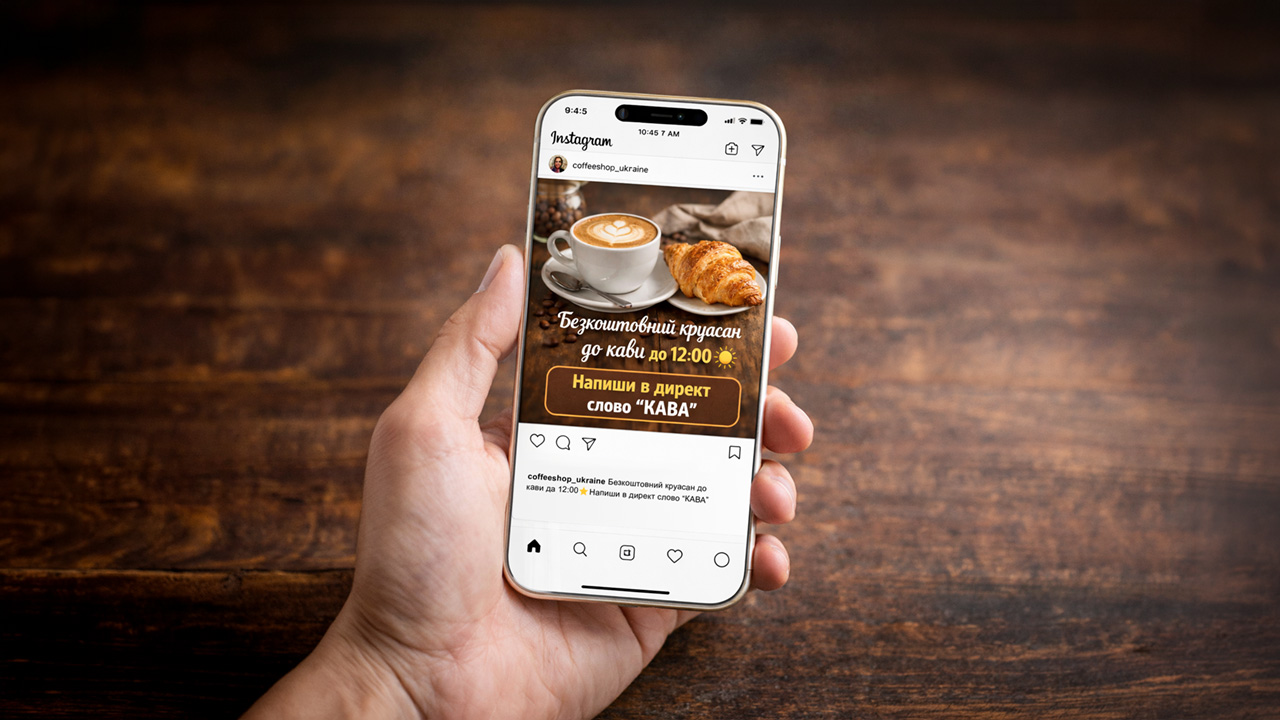
📸 Beautiful photo of coffee + croissant
Text: “Free croissant with coffee until 12:00 ☀️ Write the word ‘COFFEE’ in direct message”
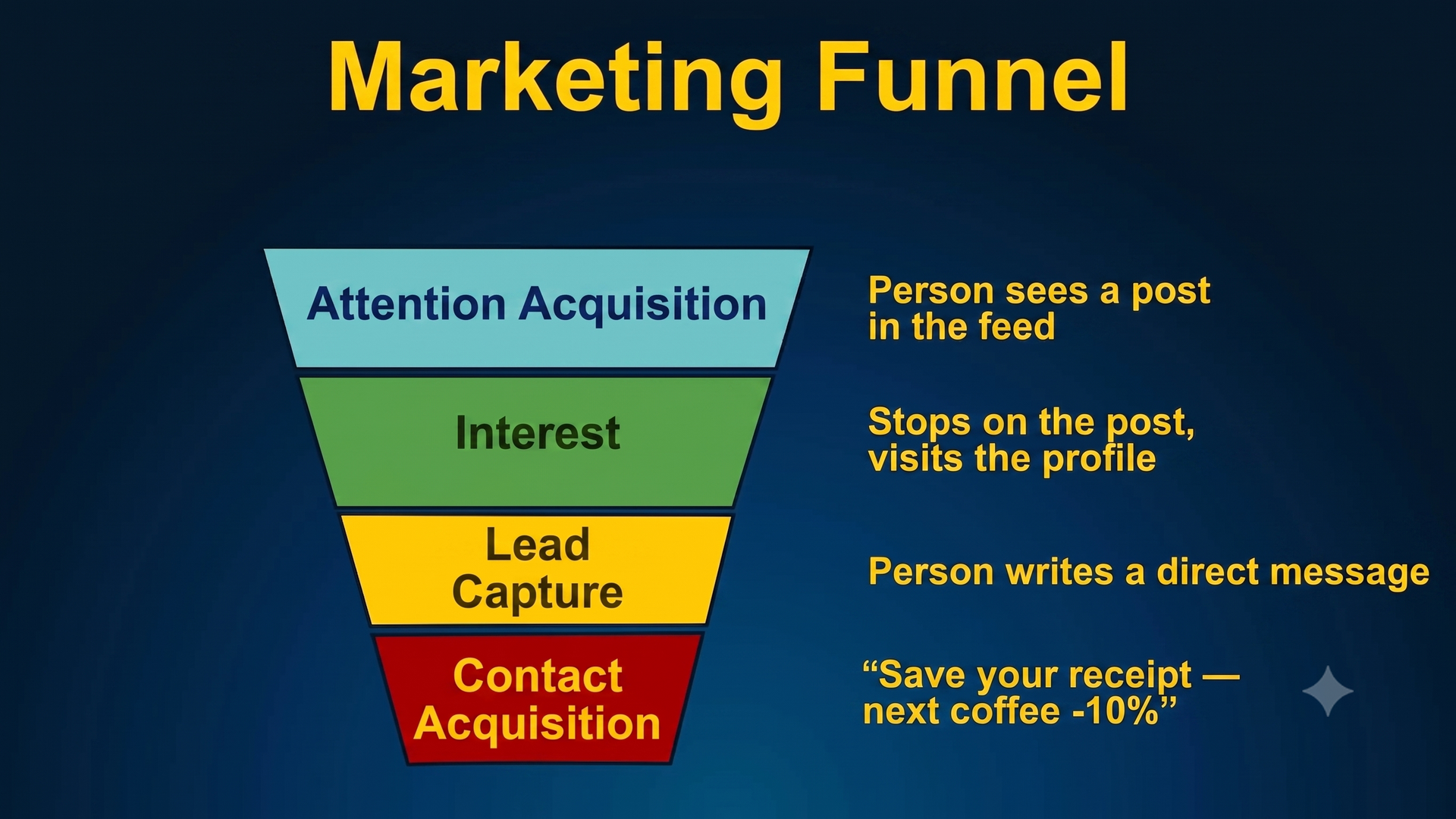
The funnel for this marketing campaign will consist of four stages:
| Stages | Description |
| Attracting Attention | A person sees a post in their feed |
| Interest | Stops on a post, reads the description, goes to the profile |
| Capturing the lead | A person writes in direct message |
| Getting a contact | Person signs up and receives code |
1. Attracting Attention
The first stage is called “Attracting Attention” — everyone who viewed the post gets here.
2. Interest
The next stage is “Interest.” This is when a person stops at a post, reads the description, and goes to the profile. This is how the reader develops interest.
3. Capturing the lead
At the “Lida’s Capture” stage, a person reads: “Write the word ‘COFFEE’ in direct message — you will receive a coupon ☕” and writes a message.
4. Getting a contact
At the “Getting Contact” stage, the person receives the answer: “Subscribe to our Instagram and get a code.” After subscribing, they receive a code, and the coffee shop receives a lead and a follower.
This way, the marketing funnel generates highly motivated leads who will rush to the coffee shop to get a free croissant. Then the sales funnel starts working, which we will discuss below.
By the way… You can try out how the Marketing Funnel works right now! Just follow the link that gives you free access to the CRM system.
Sales Funnel (Customer with Code)
Now let's talk about the sales funnel.
Unlike marketing, which is responsible for the process of attracting an audience, it is responsible for the process of turning an interested person into a customer and completing the deal, that is, it leads the lead to a direct sale.
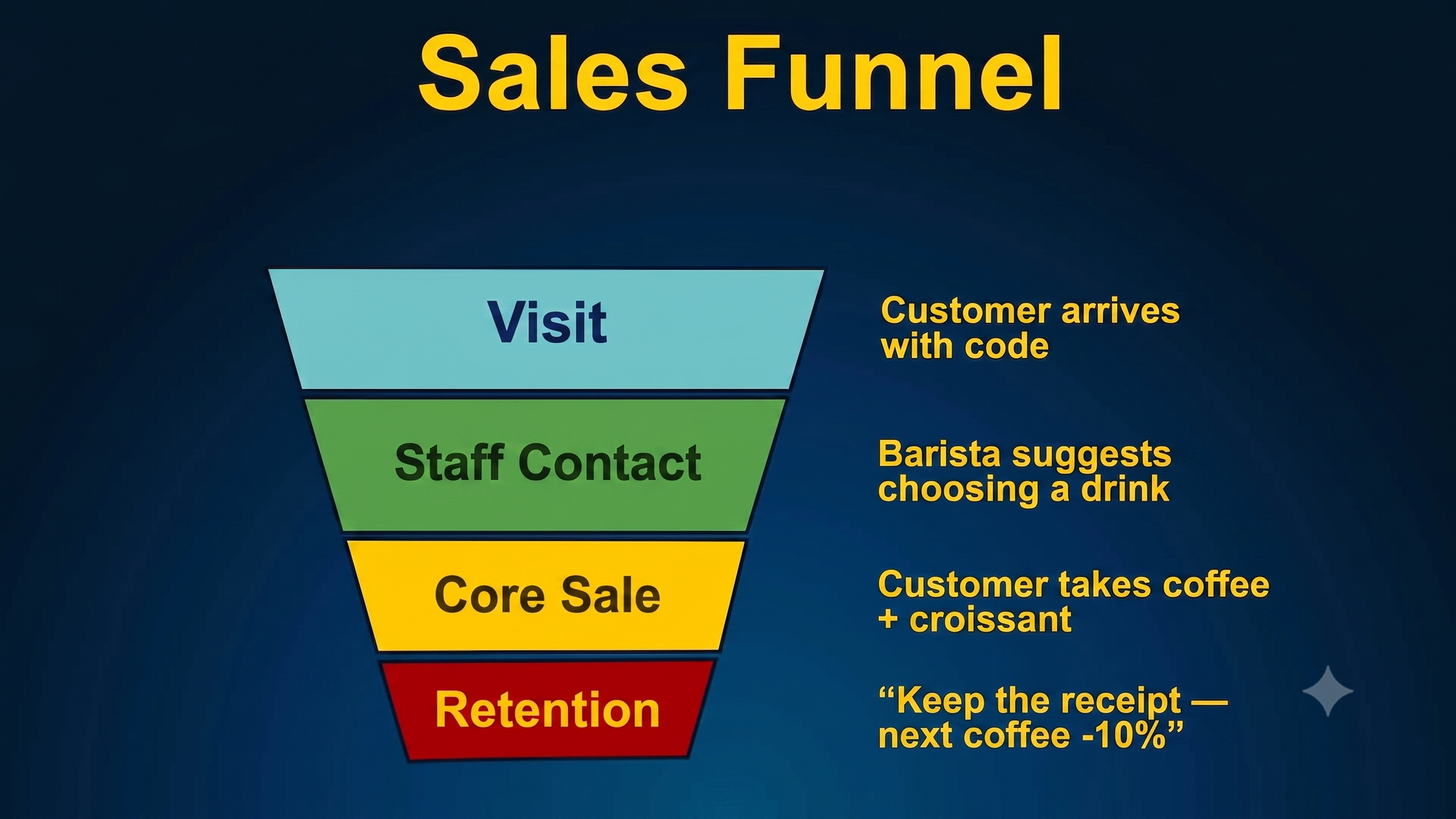
I suggest continuing the same example with the coffee shop — but for people who came with the code.
| Stages | Description |
| Visit | The client comes with a code |
| Contact with staff | The barista offers to choose a drink |
| Main sale | Customer buys coffee + croissant |
| Fixing | “Save the receipt — next coffee -10%” |
1. Visit
The first stage is “Visit.” A person comes to a coffee shop and shows a code for a free croissant.
2. Contact with staff
At the second stage, "Contact with Staff." The barista explains that in order to get a free croissant, you need to order a drink and offers a signature cappuccino ☕ with the croissant.
3. Main sale
In the third stage, the “Main Sale.” The customer buys coffee + croissant. The main sale takes place.
4. Fixing (return)
The fourth stage is “Consolidation”. After the payment has been made, you can prepare the Client for the next sale. The barista says: “Keep the receipt — next coffee -10%”.
As can be seen from the example, the sales funnel is the stage after marketing, where a “warm” customer, for example, someone who came to a coffee shop with a code, goes from entry to purchase through offers, service, and additional sales.
What's more... You can try out how Sales Funnel works right now! Just follow the link with free access to the CRM system.
So what is a Mixed Funnel?
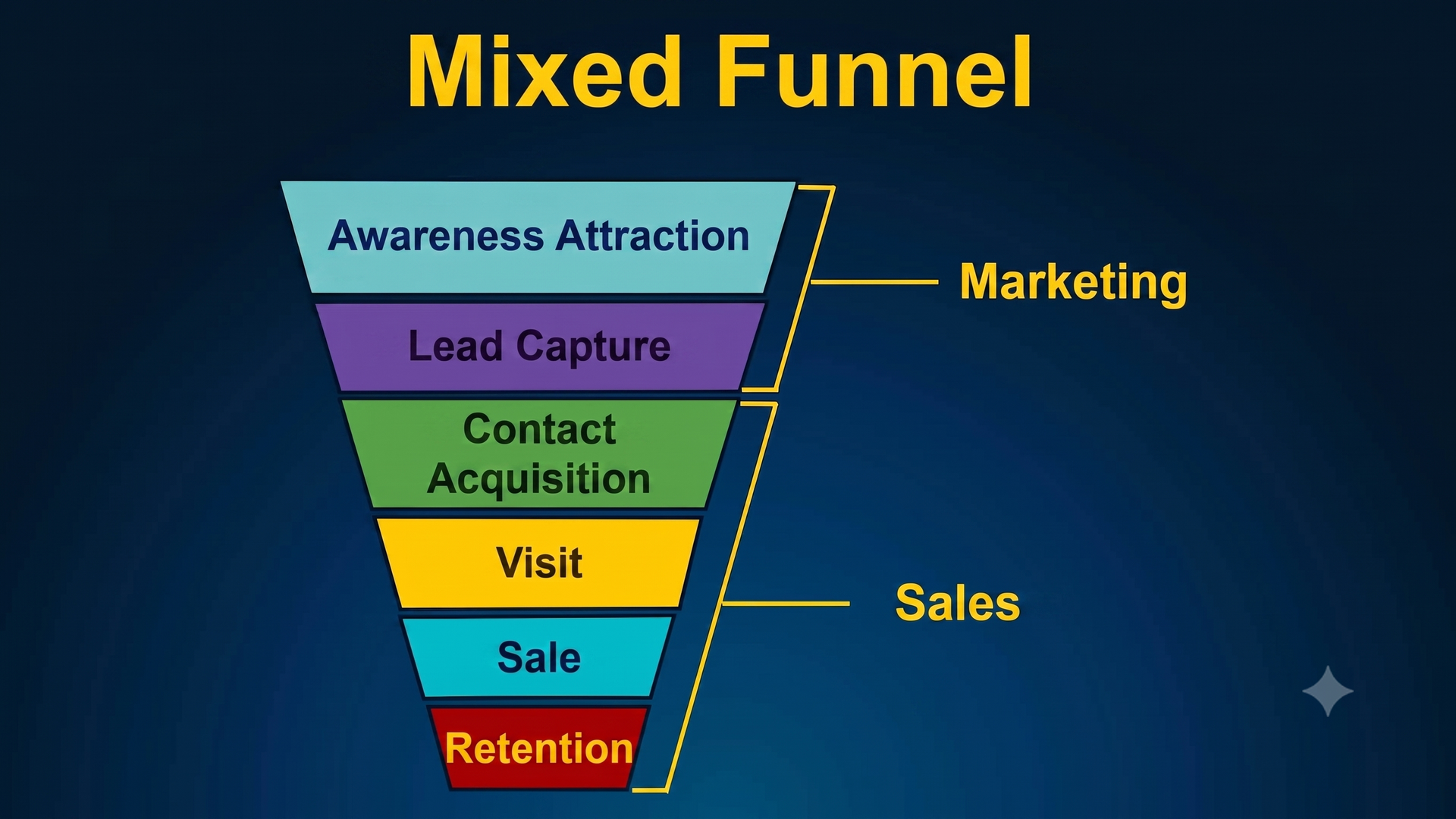
A blended funnel is a combination of a marketing funnel and a sales funnel into one system. Let’s now look at an example of a blended funnel. To do this, we will combine the previous two funnels into one, where marketing and sales are together.
Just like in the previous marketing funnel, we will use the idea with the “Free Croissant” as the goal of the funnel to get new visitors.
| Stages | Description |
| Attracting attention | A person sees a post in their feed |
| Capturing the lead | Man writing a message |
| Getting a contact | Person signs up and receives code |
| Visit | The client comes with a code |
| Selling | Customer takes coffee + croissant |
| Fixing | “Save the receipt — next coffee -10%” |
1. Attracting attention
The first stage is also called “Attention Acquisition” — everyone who viewed the post gets here, that is, the number of views is recorded.
2. Capturing the lead
At the “Capture Lid” stage, as in the previous example, the description contains a call to action: “Write the word ‘COFFEE’ in direct message and you will receive a coupon ☕”.
3. Getting a contact
At the “Receiving Contact” stage, the person writes the word “COFFEE” in direct message.
In response, she receives a message: “Follow our Instagram and get a code.”
A person signs up and receives a code, and the coffee shop gets a lead and a subscriber!
4. Selling
At the “Sale” stage, a person comes to a coffee shop with the code. The barista explains that to get a free croissant, you need to order a drink, and adds: “Our signature cappuccino goes perfectly with a croissant ☕.”
5. Fixing
At the final stage of “Consolidation”, after payment, the customer is prepared for the next purchase. The barista says: “Keep the receipt — next coffee -10%”
So, a blended funnel is when you track marketing and sales together in one funnel: from initial contact with a person to the final purchase.
Why two funnels when you can get by with a mixed funnel?
You may wonder: why create separate marketing funnels and sales funnels when you can track the entire process in one funnel?
Good question! And here’s the thing that most people don’t understand. Yes, a mixed funnel is convenient, but there are reasons to separate them. Here are three main reasons to separate your marketing funnel and sales funnel:
1. Different teams
First, in business, it often happens that marketing and sales have different teams with different managers. Where marketing is one team, and sales is a completely different one. It is easier for each team to work with “its” part of the funnel, bypassing the processes of the other.
2. Analytics and control
The second reason is analytics and control. The fact is that when the funnels are separated, you can more specifically determine what the problem is: traffic or closing deals.
Otherwise, everything gets mixed up, and it's difficult to understand where exactly the neck narrows.
3. Different levels of business
The third reason for separating funnels is the different levels of business. In small businesses, a mixed funnel often works - it's easier to operate, in large businesses, the marketing funnel and sales funnel are almost always separated, since a large amount of traffic requires more precise control and analysis.
When to do a mixed funnel then?
The question arises: how to understand when it is worth creating a mixed funnel and when - separate funnels for marketing and sales?
A blended funnel is ideal when you have a small business or a short sales cycle where a customer can make a purchase quickly. But as your business grows, you need to separate marketing and sales to better manage each stage.
Now that you know when and which funnel to use, it's time to start implementing different funnels in your business. Follow the link with free access to the CRM system and try everything yourself in practice.