Have you often encountered a situation where the number of projects exceeds your capabilities, and having started one task, the deadline for another has already passed? If your answer is “yes”, you should consider implementing time management methods into your workflow. There are many techniques for organizing your workflow, so you are sure to find the best way for you.
Lack of a comprehensive approach to organizing work often causes delays and deterioration in project quality. This can lead to increased overtime costs and sometimes even the loss of clients. The ability to properly prioritize is important, as it increases the overall efficiency of the team and allows you to gain competitive advantages.
What is time management?
Time management is a system of time management methods that help organize an effective work process. Time management technologies allow you to correctly distribute time between tasks and personal needs. This increases the level of team efficiency, improves the quality of work, and tasks are completed within deadlines.
According to Jobera, 70% of employees who don’t use any time management methods have no control over their work process. This is a large portion of employees whose low efficiency can lead to significant financial losses for the company. By dedicating just ten minutes to planning your workday, you can save up to two hours that would normally be spent on inefficient tasks.
Let's consider other benefits of proper time management:
- Effective achievement of business goals;
- Easy distribution of tasks by priority;
- Developing delegation skills;
- Increasing employee concentration and productivity;
- Preventing procrastination and burnout;
- Reducing overload;
- Improving self-discipline;
- Increased time for rest and self-development.
Basic time management skills
Effectively planning your day and organizing your tasks can significantly improve your overall productivity. However, to achieve this, you need to master key time management skills, including:
- Setting goals and objectives. Defining the main goal of the project helps to establish priorities and correctly distribute responsibilities among team members. Make sure that the deadlines correspond to the complexity of the project and all tasks are evenly distributed among employees.
- Break down your work into stages and determine how long each stage will take to complete. A clear list of tasks will save you from having to guess where to start, and deadlines will help you develop self-organization.
- Plan ahead. Spend 10-15 minutes planning your day. Determine which tasks are more important and need to be completed first. Remember that rest and personal needs also need time.
- Prioritize: Do more important tasks first, then move on to lower priority tasks. Avoid trying to multitask, as lack of concentration can reduce the quality of your work.
- Setting deadlines. Setting deadlines helps you organize your work. Use a calendar or other additional software to track the time it takes to complete each step.
- Delegation of responsibilities. Distribute tasks among team members according to their specialization. If a programmer creates content, it will not give the desired result, as in the case of a specialist.
- Minimize distractions. Create a comfortable work environment where you won't be disturbed by external factors. Find a comfortable position, turn on relaxing music, and set your phone to silent mode — this will allow you to fully focus on important tasks.
- Avoiding multitasking. Evenly distributing tasks helps avoid overloading employees with overtime responsibilities.
By acquiring these skills, you will be able to optimize the project implementation process, avoid chaos, and properly distribute responsibilities among the team.
What are the time management methods?
There are many time management techniques, so everyone can find an approach that fully meets their needs. Choose one technique, analyze its effectiveness, and after a while try another to compare the results. This approach will help you choose the option that best suits your work or business.
We have compiled a selection of popular techniques with different approaches to time management. Let's consider the features of each of them:
Pomodoro: the 25-minute system
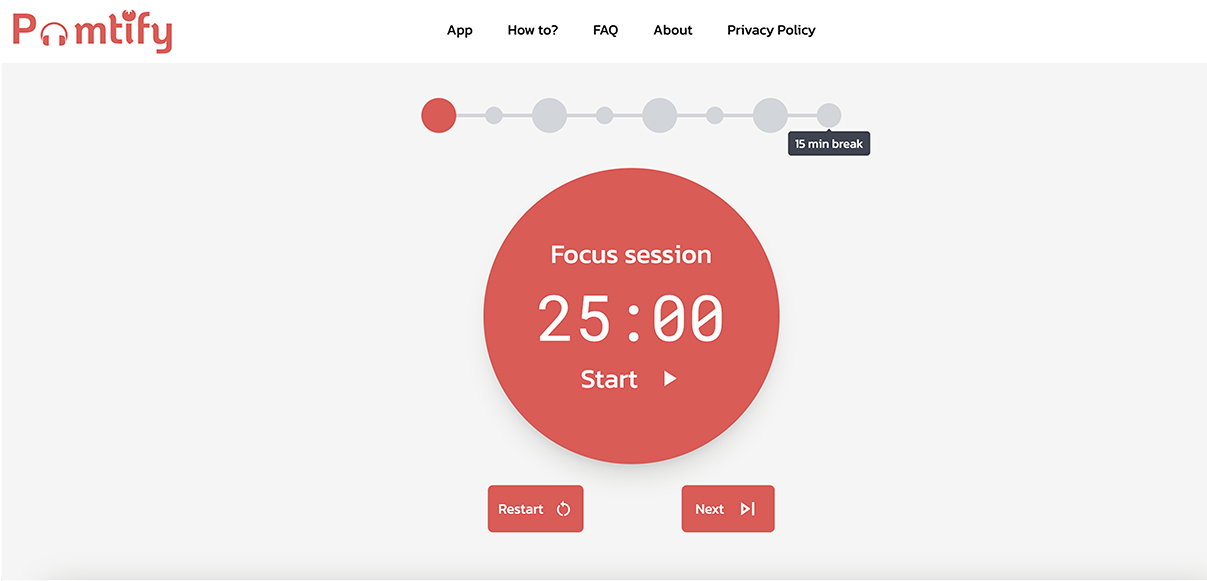
This technique was developed by Francesco Cirillo, looking for an effective way to focus on studying. He would take a tomato-shaped kitchen timer and mark 25 minutes of active work. After that, Francesco would take a 5-minute break and start the cycle over again.
After four such cycles, you need to take a full 30-minute break and reboot your brain. The main thing is to stick to a clear time frame so that the technique remains effective and does not lose its effectiveness.
The Pomodoro Technique has become widely used due to its ability to improve concentration and prevent overwork. In order not to use a manual timer, you can use special applications that automatically track the cycle. An example of an application that works on this principle is Pomtify:
90/30
A time management method similar to the Pomodoro technique. In this method, you set aside 90 minutes for productive work, followed by 30 minutes for active rest, and then the cycle repeats. If you find it difficult to work continuously for an hour and a half, try changing the intervals to 52 minutes of work and 17 minutes of rest.
In the first cycles, it is important to pay attention to the highest priority tasks, gradually moving on to simpler ones. The Eisenhower matrix, described below, will help determine the priority of tasks.
Eisenhower Matrix
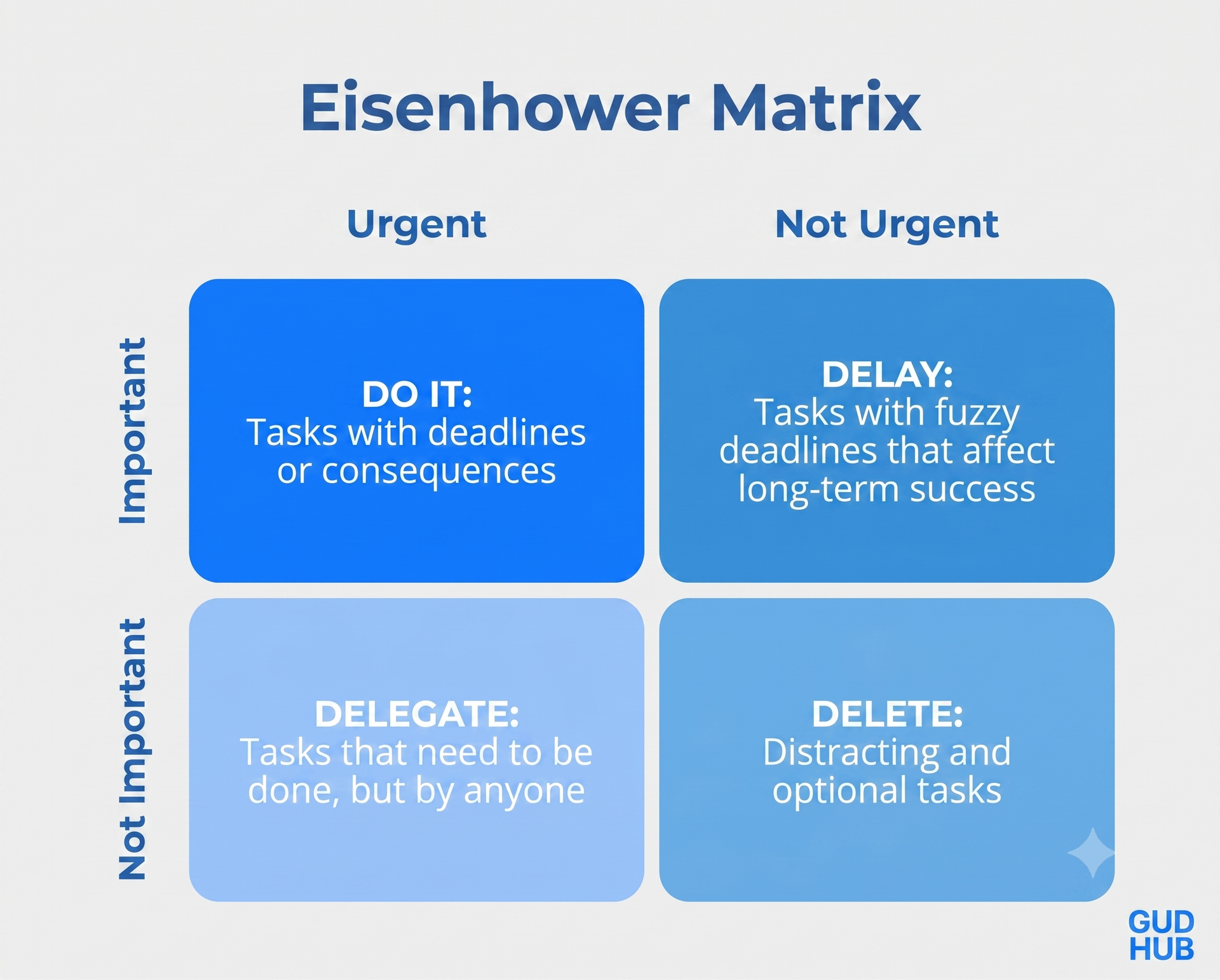
The Eisenhower Matrix is a technique for dividing tasks into four categories:
- Important-urgent: a matter that requires priority execution due to high priority and limited time.
- Important-Not Urgent: A task that doesn't have a deadline, but is absolutely essential to achieving your goals. This type of work can be postponed until after the first category is completed.
- Non-urgent: A category of tasks that do not have a significant impact but need to be resolved quickly. If you have more important tasks, you should delegate these tasks to other team members.
- Not important, not urgent: actions that are of no use. Don't waste time doing such tasks, it's better to remove them from your To-Do list and focus on priority tasks.
Example: Let’s say your company has a new client. The collaboration will start in two days, and the client needs to be given access to the system. Since the deadline allows for waiting, this task should be categorized as “important-not urgent.”.
The “eating the frog” method
Entrepreneur Brian Tracy introduced a time management method that involves doing the most unpleasant task at the beginning of the day. The idea is that by putting off such a task, a person is under constant pressure and expectation to complete it, even if the task only takes 15 minutes. Instead, you “eat the frog” in the morning and the rest of the tasks are completed quickly and productively.
GTD: getting things done
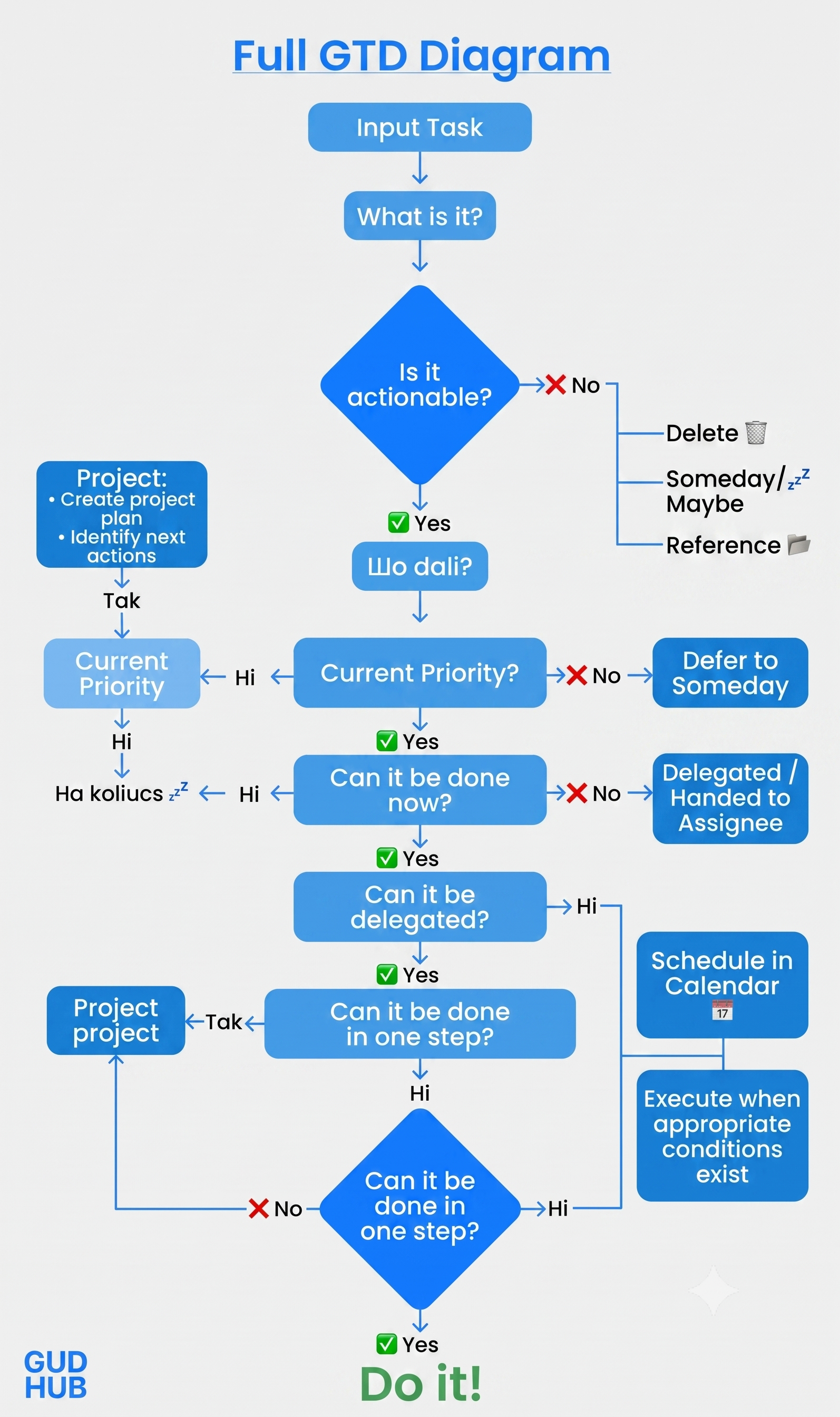
Getting Things Done (GTD) is a method by David Allen that involves bringing all tasks to a logical conclusion. It requires you to collect several tasks, determine their importance, and set deadlines using the following scheme:
- Make a to-do list. Use a convenient place for you, it can be a text document, a mobile app, or a regular notepad. The information collected will be the source for the GTD table.
- Divide tasks into categories. For example, household chores, work, development, social activities, etc.
- Determine follow-up actions for each task:
- If you can't contribute to the issue, simply delete it from your planner. If this knowledge is useful, save it in your notes for future reference.
- Next, you need to prioritize the task. If it is important but has many stages, create a project that will be developed when it becomes clear what to do first. If the task is a priority and can be completed now, move on to specific actions.
- Do tasks that take less than 2 minutes right away. Schedule the rest on your calendar or delegate them to others.
The method is more effective if you follow its basic principles:
- All tasks must be performed in turn: until the previous task is completed, the next one cannot begin.
- Every matter should be recorded, regardless of its scope or importance.
- Specificity is important in your notes; don't create overly abstract formulations.
- Keep information in a convenient and always accessible place.
- Plan important matters in advance to think through every step in advance.
- Review your list regularly to get rid of irrelevant information.
Time block method
A time management technique that helps you optimize the time it takes to complete tasks. It involves planning a clear time period for each task. For example, from 12:00 to 13:00 — processing client requests, and from 15:00 to 16:00 — time for self-development. This schedule helps you focus on completing a specific task in the time period allocated for it. This way, you will know what needs to be done at a certain moment, and you will not be able to worry about not having enough time to complete important tasks.
Using this technique, you can create not only daily but also weekly plans. For example, on Wednesday, devote time to meetings with partners, and on Thursday - to developing technical instructions.
Kanban
A Japanese method of effective time management, popularized by Toyota. Initially used only by large companies, as it was designed for teamwork, Kanban has since proven useful in personal planning. The basic principle is to visualize work tasks, divided into three groups:
- Planned;
- In the process of implementation;
- Completed.
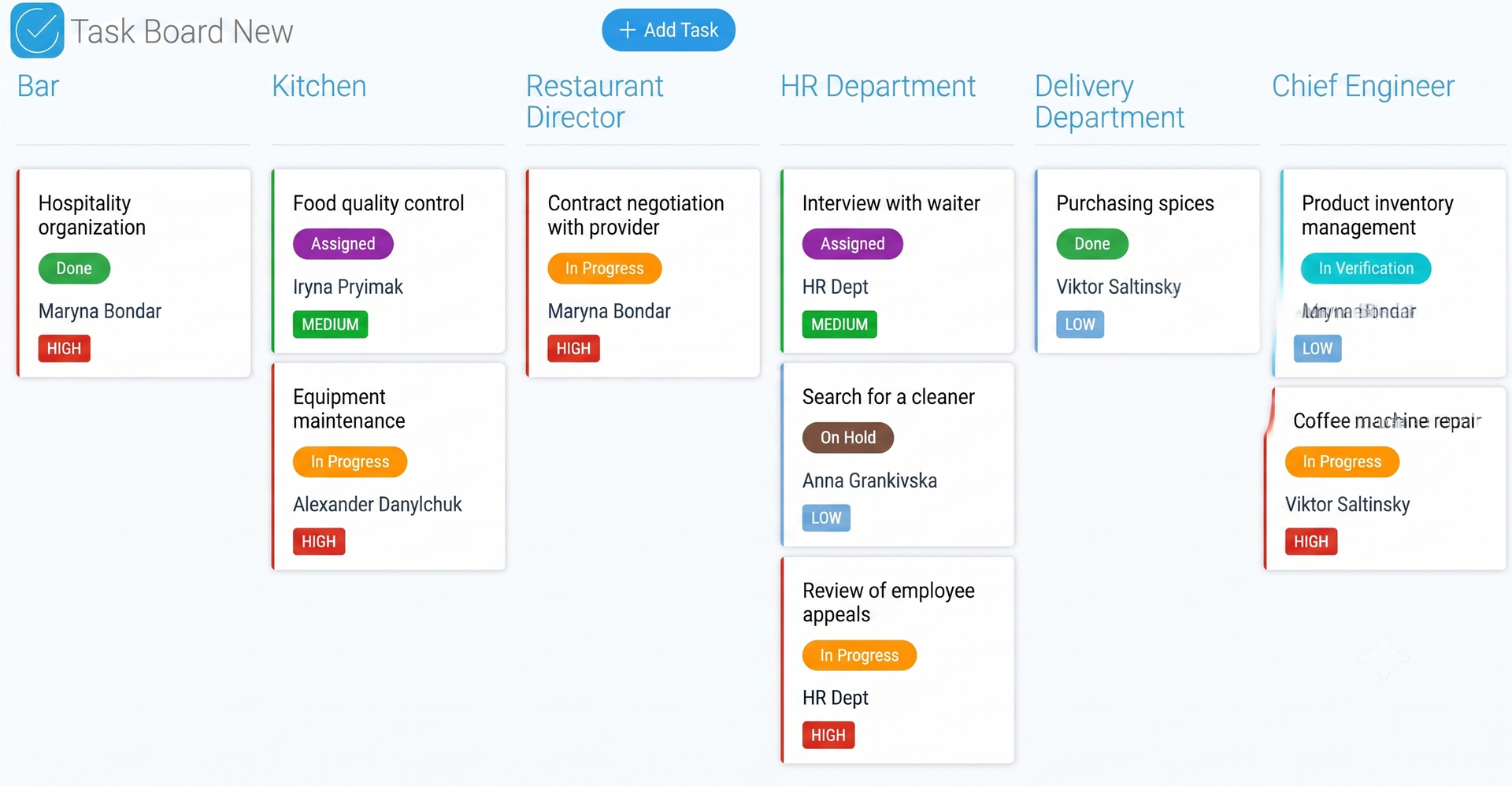
You can post your tasks on a board with stickers, write them down in a notebook, or visualize them in any spreadsheet application. This method provides a clear understanding of the scope of work, as you can immediately see which tasks need to be completed and which are in progress.
The board is fully customizable to your needs. For example, you can add more columns, change their names, or add a separate column for a specific project, adding relevant tasks to it.
Kanban is actively used in CRM systems to track the process of project implementation. Each card represents a separate task with brief information: name, performer, priority and status. This structure allows you to monitor the process of task implementation in real time and promptly respond to deadline violations.
The “1-3-5” method
This method involves completing nine tasks with varying levels of difficulty: one difficult, three medium, and five easy. If you feel tired from one task, you can move on to an easier task. This number and order of tasks makes it easy to complete, allowing you to avoid feeling tired at the end of the workday.
This time management technique helps you build a clear hierarchy of tasks that makes your day as productive as possible. The method can be easily adapted to your needs by changing the number of tasks from the “1-3-5” format to “1-2-7”.
The principle of three things
Developed by writer Chris Bailey, the technique is similar to the “1-3-5” method. The idea is to complete the three most important tasks during the day. This approach requires you to not get distracted by other tasks, even if they seem easy.
The three-task method helps you focus on key tasks instead of trying to tackle everything at once.
This method is best suited for people who already have self-organization skills and know how to plan their day. It will also come in handy if you often find yourself unable to focus on your main goal, being distracted by routine or non-urgent tasks.
The 80/20 method
This principle of time management was developed by the economist Vilfredo Pareto. He assumes that 20% of the effort gives 80% of the result. That is, you need to devote 20% of your time to priority tasks, and leave the remaining 80% to less important matters.
To have time to complete all lower-priority tasks, determine whether they can be delegated, whether they will be beneficial, or whether it is better to abandon them. It is recommended to fully focus on completing the main task, without being distracted by extraneous factors.
CRM system as a time management method
A CRM system is not only a tool for managing customer relationships, but also an effective time management method. Thanks to this software, you can assign tasks, set deadlines, monitor performance, and determine priorities. Integration with other services, such as messengers, payment systems, delivery services, telephony, and marketplaces, allows employees to effectively distribute responsibilities and avoid chaos in the schedule.
CRM for business offers a number of process automation tools, including automatic processing of applications, generating reports, managing marketing campaigns, collecting a customer base, etc. Pay attention to more priority tasks by letting the system do all the routine work for you.
Conclusions
Using time management techniques will help you effectively allocate your time between work tasks and personal needs. Remember that the basics of time management are about the right balance between work and rest, not about an overloaded calendar.
There are many time management techniques, from prioritizing tasks to using specialized business software. Choose your own way to optimize your time and implement it into your workflow. We guarantee that the right approach to time management will yield quick results!
Useful resources
To learn how to manage your time effectively, you can use the following additional resources:
- Chernyak Blog — Ukrainian popular science blog dedicated to the topic of self-development.
- Todoist — task management app: assigning priorities, setting deadlines, setting notifications, etc.
- Jeff Sutherland, “Scrum. Learn to do twice as much in less time.”
- Forest — a phone app that uses gamification to help you focus on tasks.
- Oliver Berkman, “4000 Weeks. Time Management for Mortals.”
- Trello — a project management platform that allows you to prioritize and post tasks on a board.