Intro to Scrum team
More and more people have become interested in agile project management methodologies and their features. And this is not surprising, because they can be used effectively in any industry, but they are especially well suited for IT. And with top business priorities revolving around customer satisfaction, cycle times, and faster time to market, Scrum structure has become the obvious solution for many organizations. As a team begins to use Scrum organization, its work tends to become more coherent and predictable, and the timeline for developing new products is significantly reduced.
We will talk not only about the key features of the Scrum framework and its scope but also about Scrum team roles that govern the whole process, how many people should be in a scrum team and the main benefits of the framework.

What is a Scrum team?
Firstly, let’s remember what Scrum is. Scrum is an Agile framework that helps people, teams, and organizations create value through adaptive solutions to complex problems. In other words, Scrum is an iterative project management framework for implementing the agile methodology. Not many people know that Scrum agile is actually the name of one of the figures in a game of rugby.
The agile Scrum approach divides the workflow into equal sprints - usually periods from a week to a month, depending on the project and the sprint team. Before the sprint, tasks are formulated, in the end, the results are discussed, and the squad starts a new sprint. Sprints are very convenient to compare with each other, which allows you to manage work efficiency. As soon as the sprint is completed, it is reviewed - an assessment and analysis of the work done in order to understand what can be improved. Thus, Scrum allows to best follow the principles of Agile development.
Scrum has a system of roles, events, rules, and artifacts. In this model, teams are responsible for creating and adapting workflows. There can be about seven people in an agile scrum team. To establish and organize Scrum roles in the Scrum team, the Scrum team organization chart templates are mainly used.
So, the core of Scrum is a small team of people, the Scrum team. A scrum team usually consists of Scrum Master, Product Owner, and Developers Team. This is a close-knit association of professionals, at any given time, focused on one goal. Thus, the whole Scrum team owns quality.
Scrum team structure
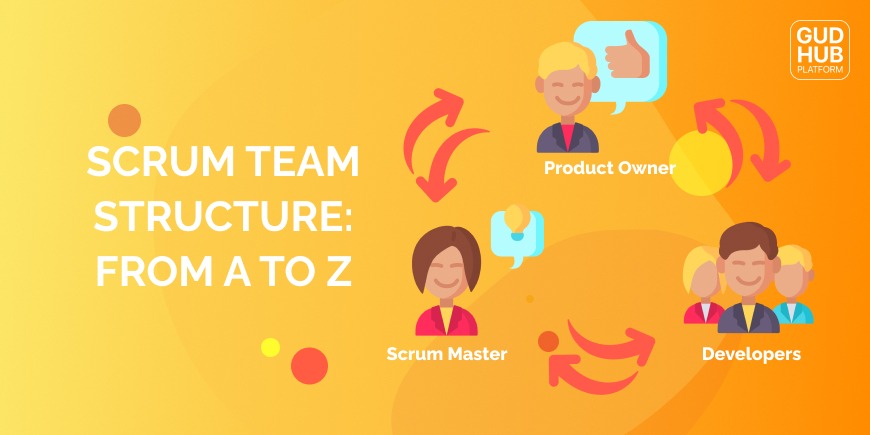
Unlike traditional development structures, Scrum teams do not have a structural hierarchy. Instead, they are self-driving and feature-rich. All Scrum team members are equally important and together have all the skills and knowledge needed to create a working product. You should not confuse scrum team composition with Agile team structure, as Scrum is a framework that has its own structure. There are some roles, which together form a Scrum team:
Product owner
The Product Owner is a person who is on a Sprint team communicates the needs of the custom/stakeholder to the developers but is not responsible for the technical side of the process. He is the one not who decides what the team will work on in Agile, but what value the group creates in the current sprint, and what they will postpone for the next. Thus, the Product Owner is in charge of maximizing customer value. "What can we do in the next sprint to make it as valuable/useful as possible?" This is a question the Product Owner should be thinking about every day in preparation for the next sprint.
An important difference between a Product Owner and any other role in traditional project management is that he remains actively involved at all times. For example, a product owner evaluates the remaining work and sets new priorities for it when needs change and new feedback comes in. The most essential responsibility of the Product Owner is to create and control the Product Backlog. In addition, the product owner is responsible for communicating to everyone involved in the change process and its impact on the sprint team. The Product Owner is in charge of creating a product that is truly cool and valuable to customers.
So, the main duties of the Product Owner in managing the project are:
- defining product backlog items;
- the correct arrangement of elements to optimize the achievement of the goal;
- ensuring transparency and clarity of the requirements that the entire sprint team will have to work on;
- general optimization to achieve the greatest value of the development team's work;
- responsibility for understanding the backlog by the development team.
Scrum Master
According to the Scrum hierarchy, each team must have a qualified Scrum Master. This person manages the correct use of Scrum and helps the product owner and developers get work done without obstacles and distractions. Scrum Master is in charge of all Scrum events. The Scrum Master is the one who is responsible for a scrum team’s performance, the facilitator of its work. All communication between people outside the squad and the developers goes through the Scrum Master.
Scrum Master is an arbiter who organizes and conducts meetings, monitors compliance with all agile Scrum principles, resolves contradictions and protects the scrum members from distractions, is in control of recording, storing, and issuing Scrum inventory. He helps the team become self-governing and teaches developers that they (albeit with the product owner) are responsible for the product. He teaches people to negotiate with each other, helps them to rally and trust each other more. The Scrum Master does not give instructions but fixes problems that arise within the squad. So, he is the one who should make sure everyone on the scrum team understands the importance of the core values and principles. With a qualified Scrum Master, the transition to Scrum goes smoothly with minimal hassle.
Development team
Developers perform all technical development tasks. The Scrum Development Team consists of specialists of different profiles: programmers, testers, analysts, architects, marketers, etc. They are cross-functional; their cross-functionality depends on the area of work. However, the developers are always in charge of creating the sprint backlog, ensuring quality as defined in the finished product, adapting the plan according to the sprint goal, and their own expert areas of responsibility.
This team is the only fully involved participant in the development and is responsible for the result as a whole. Its goal is to make a quality product, jointly finding suitable solutions for this and not waiting for outside instructions. The scrum development team is self-sufficient, self-governing, and self-organizing. It is like a kind of single organism, consisting of separate elements.
The team works together: it determines how to achieve the goals. For the individual features it is working on, the product owner determines the priority. How the work proceeds determine the agile Scrum process that the Scrum Master is in control of. Everything else is decided by the group, and the Scrum Master should do his best to ensure that everything happens that way. For example, each scrum team member can take on a feature from a refined product backlog and decide for himself how to get the job done.
Also, we can’t forget about other participants of the Scrum project - stakeholders and SMEs. Stakeholders are persons who initiate the project (business customers), to whom the Scrum project will benefit. They are only involved in agile Scrum during the Sprint Review. SME agile is the person with the essential knowledge that a team needs to successfully deliver a product.
Such authority is at the core of Scrum’s structure. They establish close collaboration between team members and create a positive work environment. Although teamwork is present in the waterfall model, in the latter squad is managed by the project manager, it is not self-organized.
What is the recommended size for a scrum team?
Now, let's figure it out, how many people should be in a scrum team? The recommended size of a scrum team is from three to nine people. The ideal Scrum team size - seven, with one product owner, one scrum master, and five developers. If there are more people in your case, then to use Scrum you need to combine people into several Scrum teams. When the team is more than 11 people, then the team is larger than the recommended Scrum size. If scrum groups become too large, they should use the Scrum of Scrums methodology.
Then the team is divided into various Scrum teams. Each has its own Scrum Master and Product Owner. Scrum of Scrums allows multiple Scrum teams to discuss work, focusing on common areas and mutual integration.
However, it is important to remember that in the formation of a development team, the most important are the factors that take into account its needs and not arbitrary numbers:
- Sufficiently broad skillset for product development - cross-functionality.
- Members work only in one team.
- Stability of work - a person participates in a team for a sufficiently long period of time.
- Diversity of thinking (and preparation) - A sufficiently wide range of ideas, backgrounds, beliefs, genders, and life experiences are beneficial for creativity and diversity in approaches.
Why Scrum is a success?
The agile scrum framework has six main advantages:
Responding to customer needs. Traditional waterfall organizations build important features and functionality into a two-release schedule a year - and often lose customers in the process. If customers don't leave, they can still be dissatisfied and leave overtime when they meet a more responsible competitor. By working in short and frequent cycles, you can deliver products to customers almost on demand and quickly adapt to new requirements. Scrum organizations give the client the ability to make changes to requirements at any given time (but do not guarantee that these changes will be implemented). The ability to change requirements is attractive to many software customers.
Reduced development costs. Agile and Scrum have proven to be economical and effective. In these models, the roles of developers are more varied, because small units can be effectively tested by the same group that developed them. Specialization disappears or diminishes, ultimately cutting costs.
Pleasure at work. By delivering products quickly, the squad has an added joy every time a job is done and sent out into the world. Every Scrum group knows how enjoyable the release is.
More quick income. Funds from clients do not come twice a year, but much more often. New features can also be added not twice a year, but much more regularly, thus bringing in more customers and processing their special requests faster.
Easy to learn and saves time. Scrum is quite easy to learn and saves time by eliminating non-critical activities. Scrum allows you to have a potentially workable product at the end of each Sprint.
Finally, Scrum focuses on a self-organizing, multi-functional sprint team capable of solving the necessary tasks with minimal coordination. This is especially attractive to small companies and startups, as it eliminates the need to hire or train specialized executive staff.
Achieve your goals and succeed with the GudHub No-code platform. Learn how it combines the Agile and Scrum tools.

Outcome
In this article, we've skimmed three roles in the agile Scrum team, but from this overview, it is clear that all roles are unique to Scrum’s organizational structure - each of the Scrum team members has responsibilities and is responsible for the implementation of the project. Moreover, each role complements the others; the success of the project depends on how well each Scrum team member is learned and how quality and much they can interact. When an organization moves to Scrum, it needs to support all three roles, develop expertise in them, and avoid comparisons to the waterfall model. Besides, we mentioned scrum team definition and what its features are, and named the main reasons why implementing the Scram will succeed.
Scrum is an iterative project management framework for implementing the agile methodology. Not many people know that Scrum agile is actually the name of one of the figures in a game of rugby.
The agile Scrum approach divides the workflow into equal sprints - usually periods from a week to a month, depending on the project and the sprint team. Sprints are very convenient to compare with each other, which allows you to manage work efficiency. Scrum allows to best follow the principles of Agile development.
Scrum has a system of roles, events, rules, and artifacts. In this model, teams are responsible for creating and adapting workflows. There can be about seven people in an agile scrum team. To establish and organize Scrum roles in the Scrum team, the Scrum team organization chart templates are mainly used. A scrum team usually consists of a Scrum Master, a Product Owner, and a team of Developers. This is a close-knit association of professionals, at any given time, focused on one goal.
The ideal Scrum team size - seven, with one product owner, one scrum master, and five developers. If there are more people in your case, then to use Scrum you need to combine people into several Scrum teams.
The agile scrum framework has six main advantages:
- Responding to customer needs
- Reduced development costs
- Pleasure at work
- More quick income
- Easy to learn and saves time
- Scrum focuses on self-organizing