For any business to remain successful and competitive, it is necessary to regularly assess the effectiveness of all its processes. There are a number of metrics, the analysis of which allows you to identify problems in time, optimize processes, improve service quality and increase employee productivity. One of such data is HR analytics indicators, which help analyze workforce efficiency and build successful strategies to improve the performance of all employees.
Using HR process analytics, you can make decisions based on statistical data, making them more informed and rational for the entire company. Our article will help you understand all HR indicators and methods of their application, contributing to maximum team efficiency.
HR analytics: what it is and how it affects personnel decisions
Human Resources (HR) analytics is the process of collecting data about candidates and employees in a company. Workforce analytics is important because it helps to understand the reasons for changes in staff productivity, make rational decisions, implement new corporate rules and improve the organization of the work process.
Analytics help HR professionals follow not only their intuition, but also specific analytical indicators, which ensures accuracy in making important decisions for the company. For example, workforce indicators help in selecting the right candidate for a vacancy, as they allow you to compare behavioral data, experience level and skills of all applicants.
Companies store a range of employee data, including their personal preferences, career history, professional skills, contact information, etc. Using HR analytics, you can structure this information and highlight the information that is key to making important decisions.
Why do you need analytics in HR?
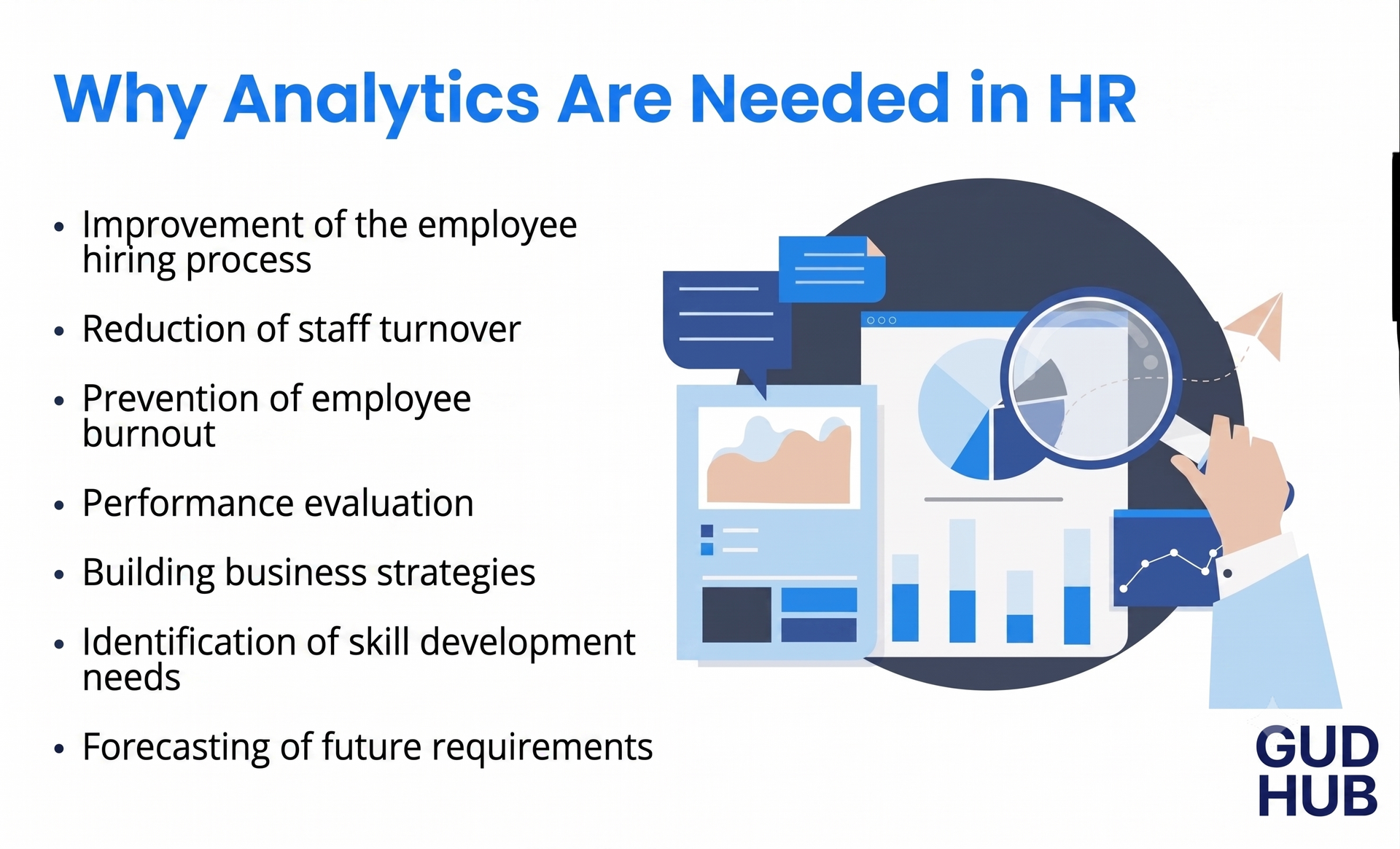
HR analytics helps you identify all the difficulties and experiences your employees are facing. This allows you to improve the workflow, prevent burnout, avoid overload, and increase motivation and engagement in projects.
Among other benefits that a company receives by using HR analytics:
- Improving the hiring process. Analysis of candidate match metrics helps optimize hiring and speed up job closing.
- Reducing employee turnover. Identifying the reasons for employee dissatisfaction with the organization of the work process helps increase their loyalty and create comfortable working conditions.
- Avoiding employee overload. Evaluating the performance of each team member allows you to distribute tasks evenly and avoid their excessive volume.
- Performance assessment: Analytics can help identify factors that affect employee performance and find ways to improve their performance.
- Building business strategies. Determining the potential of workers allows you to build long-term plans and make strategically important decisions.
- Identifying skills development needs. Assessing the professional level of employees helps determine the need for additional training, upgrading skills, or hiring a more experienced specialist.
- Forecasting future needs. Analysis of age, demographic and other indicators allows you to predict the need to attract new employees.
Types of HR analytics
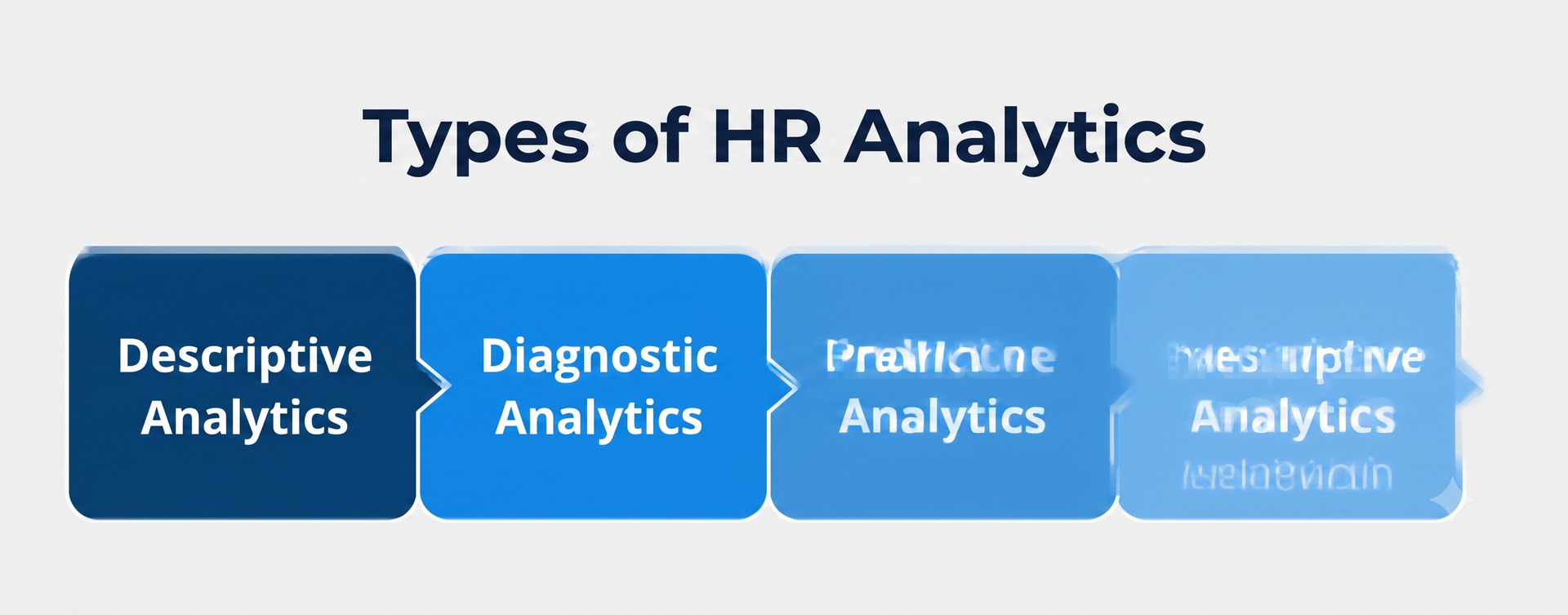
There are four main types of workforce analytics, the need for which depends on the specifics of your company and available resources. Each of them is aimed at achieving different goals, but their integrated application provides comprehensive control over HR processes. Let's take a closer look at the features of each type:
Descriptive analytics
This is the simplest method of analyzing HR data, focusing on what has already happened, without predicting future events. This allows HR professionals to evaluate past events and identify patterns or inconsistencies over time. Basic mathematical calculations may be required to process such data.
For example: this method can help determine the time of year when employees most often take vacation.
Diagnostic analytics
This type of analytics is closely related to descriptive analytics, as it uses previously obtained events and explains the reasons for their occurrence. HR specialists analyze demographic, social and other indicators to determine the reasons for the occurrence of a particular situation. Thus, previously obtained information is converted into valuable data that helps to predict the future and develop effective strategies.
For example: thanks to the data obtained from this study, it is possible to identify factors that influence the level of employee involvement in corporate processes.
Predictive analytics
This method of HR analytics involves grouping together all available historical data to create predictions, including about employee skills, employee turnover, and the level of involvement in corporate events. HR analysts examine past events, looking for patterns and correlations to build strategies and business plans. This is a complex process that requires processing a large amount of data to predict all possible nuances.
For example: predictive analytics allows you to predict the risk of employee dismissal due to changes in their behavior or the influence of external factors.
Prescriptive analytics
This is the most complex level of HR analytics, involving making specific decisions based on the forecasts received. It is necessary to determine further actions to ensure that all possible scenarios are addressed. This often involves the use of additional resources such as artificial intelligence, machine learning, cloud computing and algorithms.
For example: knowing about the risk of firing a valuable employee, you can develop an action plan in advance to keep him on the team.
HR analytics: key indicators
HR analytics identifies key metrics that help you better understand your company's employees: their preferences, professional skills, and attitude toward the company. However, this data is not universally valid, as it all depends on the specifics of your niche, seasonality, the human factor, and other factors that influence employees' decisions.
To make the information received as effective as possible, it is necessary to conduct a deep analysis, identify patterns, correlate it with current trends, and identify possible problems. Key indicators of employee effectiveness include:
Job closing time
The faster the HR department finds a new employee, the better. However, it all depends on the specifics of the vacancy and the professional level of the candidate. According to statistics from Robota.ua, the average time to hire a worker for a management position is 90 days, and an entry-level specialist - 21 days.
An equally important factor affecting the speed of finding candidates is the level of workload of HR managers. If the workload is so high that there is simply not enough time to search for and communicate with candidates, the hiring process is delayed. To avoid this, you can use special programs that speed up the hiring of workers through automation.
Employee turnover rate
This indicator helps to assess the effectiveness of HR processes and understand how well new employees are adapting. It also shows the level of staff stability in a particular position and allows you to identify the main reasons for dismissal.
The turnover rate allows HR professionals to respond to problems in personnel management in a timely manner and take measures to improve these processes. If the indicator increases sharply, it is worth paying attention to the atmosphere in the team, employee workload, career growth opportunities and working conditions.
Time and cost of employment
The employment process includes several stages: communication with the HR manager, completing a test task, agreeing on details, and signing documents. However, sometimes it can be delayed due to an unprepared workplace, delays with documents, or overloading of the HR department.
Controlling the timing of closing vacancies is important, as delays can negatively affect the company's image and raise doubts about the competence of its workers. Also, do not forget that with the increase in terms, costs also increase, in particular for posting vacancies, conducting interviews, analytics and the work of HR specialists.
Average age of employees
It is important to understand the age group you are working with in order to better understand the values and needs of your employees. This is useful for building a quality corporate culture, making the right management decisions, and creating a friendly atmosphere in the team.
Level of loyalty to the company
The level of employee loyalty and engagement is an important indicator, as it helps to understand what employees like and what needs improvement. You can determine this indicator by conducting eNPS surveys, the purpose of which is to divide employees into three categories: critics, passive, supporters. Thanks to this, you can assess whether the company is moving in the right direction, how well-organized human resources management is, what is the level of corporate culture, and whether employees strive to work for the development of the company.
Employee satisfaction
HR analytics allows you to objectively assess whether employees are satisfied with working conditions, including salary levels, workplace, team, and workflow organization. Conduct a survey to give employees the opportunity to express their comments and wishes, so you will find out which aspects of the business need improvement.
Period of office
By analyzing the period during which an employee holds a certain position, you can predict the moment when he will be ready to make a decision to leave or move to another qualification level. This allows you to identify problems that the employee may encounter in advance and eliminate them in advance. For example, you can prepare the necessary training materials that will help the employee improve his skills and increase his level of qualification.
A selection of tools and techniques for high-quality analytics of HR processes
HR analytics is a long process that requires in-depth analysis of all key employee performance indicators. It requires accuracy in calculations and attention to detail, as future business goals and strategies for achieving them are formed based on the results obtained.
Special tools that automate the collection of employee data, create reports, build forecasts, and perform many other tasks will help simplify this process. Among them:
- CRM system for HR. This software creates a single database of candidates and employees, where you can manage their data. CRM automatically generates reports with employee performance indicators, their loyalty index, and vacation statistics. This helps HR specialists make informed decisions about personnel and develop sound business strategies.
- Human Resources Management System (HRMS). This tool simplifies the work with employee data by grouping all the information and creating detailed reports. For example, you can view statistics on the time spent by an employee on a particular task. This allows you to track the efficiency of each employee, without the need for independent calculations.
- Conducting surveys. Feedback from employees allows you to objectively assess their level of satisfaction with various work aspects and eliminate the problem in a timely manner. Surveys can have different focuses: analyzing relationships in the team, finding out the reasons for frequent vacations, or assessing employee productivity.
- Business Intelligence (BI) is a tool that transforms large amounts of data into structured information suitable for analysis. Key performance indicators are displayed in visual reports, which facilitates analysis and management decision-making.
- Collect customer feedback. User experience analysis helps to assess the quality of all stages of customer service. For example, a customer may note that he liked working with the company, but the order process took too long. This will allow you to understand that the efficiency of the employee responsible for this was lower, and you need to determine the reason for this.
How to get started with HR analytics
To start HR analytics, you need to define a clear plan for implementing this technology into your workflow. It is important to formulate the goals of the analytics, select data sources, and select supporting tools to structure them. Properly configured HR process analytics allows you to qualitatively assess the effectiveness of the entire team and make informed decisions regarding personnel management.
Let's take a look at the main steps that will help you organically implement HR analytics into your workflow:
Determining the purpose of data collection
It’s not enough to simply collect employee data and try to find patterns in it. It’s important to have a clear understanding of what aspects of your business you’re trying to improve or what problems you’re trying to solve. This will allow you to focus on examining specific data points.
For example, if you are looking to optimize time management, you should analyze how much time employees spend on certain tasks, assess their workload and level of procrastination.
Data collection
Once the problem has been identified, it is necessary to collect relevant data to solve it. This can be done in various ways:
- Conduct a survey among employees;
- Collect customer feedback;
- Use a personnel management system.
You can optimize the process of working with large amounts of information thanks to special programs for organizing, sorting, and visualizing data.
Processing of collected information
At this stage it is necessary:
- Structure the collected data:
- Filter and leave only useful information;
- Check it for relevance, truthfulness, and uniqueness.
Errors, inaccuracies, and repetitions can degrade the results of the analysis and should be eliminated.
Data analysis
After processing the data, you can move on to analyzing patterns, trends, and anomalies. Various tools are used for this, including:
- Cloud computing;
- Artificial intelligence;
- Data processing algorithms;
- Spreadsheets.
At this stage, the collected data is converted into analytical information that can be used for forecasting and making management decisions.
Evaluation of the results obtained
On the basis of the conducted analysis, you can form company development strategies, without doubting their effectiveness, because they are based only on accurate data. Also note that HR analytics must be regular, so after implementing certain solutions, it is necessary to constantly monitor their effectiveness and adjust strategies according to new trends.
Conclusion
HR analytics is a powerful tool for effective HR management and achieving the company's strategic goals. It allows you to track key performance indicators of employees, which helps you better understand their skills and professional growth opportunities. Thanks to this, you will not only better understand your team, but also be able to timely identify problems in work processes and determine the need for new personnel.
Using additional tools for HR process analytics allows you to optimize work with large amounts of data by structuring and organizing it. Use tools such as CRM systems, HR management platforms, and business data analytics to automate information processing, freeing up time to generate strategic decisions for the company's development.